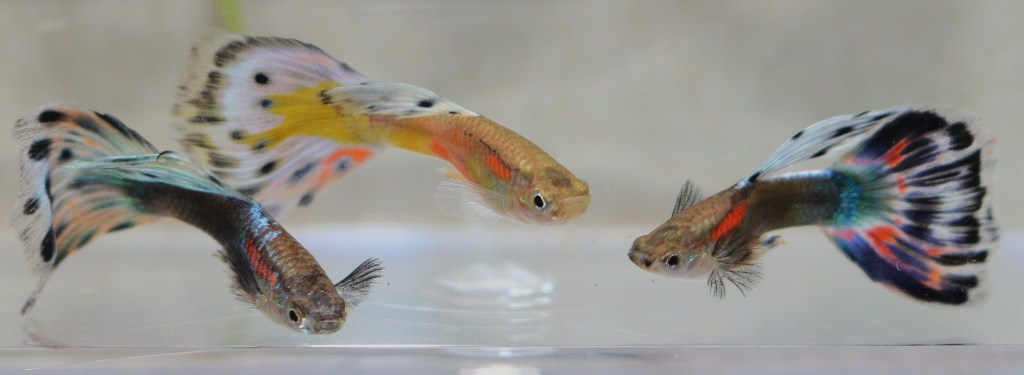
Many aquarium hobbyists breed their fish with little concern about inbreeding’s negative effects on their fishes’ fitness (i.e., survival, reproduction, and disease resistance). Most leaders in the aquarium hobby have dismissed or ignored inbreeding’s negative effects. Inbreeding’s positive effects stemming from selective breeding for desirable traits have gotten all the attention. My new article ‘Inbreeding and Fitness’ incorporates recent scientific discoveries that better document inbreeding’s negative effects and what factors make them worse. As more fish species face extinction—a good part of it driven by inbreeding—I believe this subject will become increasingly relevant to fish-keeping in the aquarium hobby.
Category: Fish Keeping
Crossing Guppies with Endlers
Recently, I crossed my Rainbow guppies with Santa Maria Endlers to increase their fitness. It is too early in this project to report on any fitness improvements. However, I can say that I am delighted with the initial phenotype results. The first generation (50% Rainbow and 50% Endler) produced a mixture of phenotypes but no significant problems; the second generation (75% Rainbow and 25% Endler) produced plenty of gorgeous, Rainbow-type individuals (Figure). Attached article explains the importance of choosing which sex to use for the outcross, “sperm turnover” time, etc. It also discusses inbreeding’s effect on fitness–a sorely neglected subject in the aquarium hobby.