Small-Scale Guppy Breeding

How to breed nice guppies in just 8 planted tanks

Holding Tank
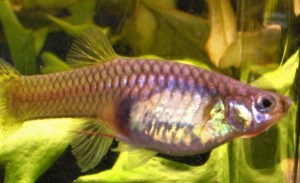
Male guppies that I have bred and raised in my small-scale breeding operation

My article Small Scale Guppy Breeding describes how I breed fancy guppies in just nine tanks.  Articles covers the basics, but it contains new, vital information on guppy reproduction.  Learn why I keep “chase” females with my juvenile males, why one female accepted and quickly mated with a new male but her full-sister rejected him…  Learn the pros and cons of separating the sexes, how I breed for fitness…  Overall, the article celebrates the guppy’s genetic trait of color polymorphism.  Unlike breeding methods that emphasize strain uniformity, I work with the guppy’s natural tendency to produce different color patterns (Photo).  This not only makes guppy breeding more fun but avoids inbreeding problems and genetic weaknesses.

Flukes and Sick Guppies

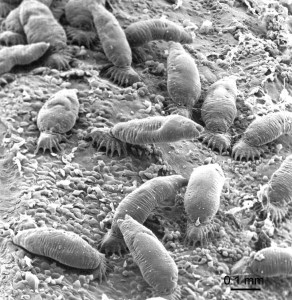
Flukes and Sick Guppies (8 pages) tackles the problem of why guppies die for “no good reason.” It starts with the author’s discovery of skin flukes (Gyrodactylus species) on her own guppies.  Apparently, these Monogenean parasites have been a major, long-standing pathogen of the guppy (Poecilia reticulata).  The author describes treatments and disease management strategies.  Photo (magnified) shows Gyrodactylus flukes feeding on the outer mucus layer of a heavily infested salmon.

Parasite Surveys

Which parasites are most prevalent in tropical aquarium fish?  My article Parasite Surveys of Aquarium Fish, a compilation of 11 different investigations from around the world, answers that question. Freshwater fish (goldfish, guppies, tetras, etc) were sampled from Sri Lankan fish farms, Swedish pet shops, etc.  Most surveys reported Monogeneans (i.e., flukes) as the most common parasite of aquarium fish–whether healthy or diseased.  For example, 37% of 223 freshly caught wild fish from the Amazon carried Monogeneans, ranging from a 92% prevalence in Angelfish to only 7.4% in Cardinal Tetras.  The ICH parasite was in second place (21% prevalence in the 223 fish), but other studies reported a much lower prevalence of the ICH parasite. Overall, Monogeneans dominated.

Treating Fish for Nematodes

Successful eradication of Camallanus worms in guppies and other tropical fish using fenbendazole and levamisole

Over the years, I have had to deal with nasty Camallanus worms several times in newly purchased fish. My article ‘Treating Fish for Camallanus and Other Nematodes’ contains step-by-step instructions for preparing a Fenbendazole-containing fishfood that successfully rid my tanks and fish of these intestinal parasites. I have also described treatment using Levamisole HCl, another highly effective drug.  Article describes the worldwide presence of Camallanus and the related Capillaria parasite.  Photo shows a Camallanus worm slowly being expelled from the anus of a female guppy during the Fenbendazole treatment.  (She recovered fine.)

Mycobacteriosis in Aquarium Fish

Stopping an outbreak of Fish TB using UV sterilizing filters instead of tearing tanks down and starting over. Managing mycobacteria rather than eradicating them. Scientific surveys on the presence of mycobacteria in the aquarium fish trade.

BettaCropJaw lesionLRMycobacteriosis in Aquarium Fish, a 15 page article, provides vital information that fish keepers can use to prevent—or deal with—“Fish TB.” Scientific surveys show that almost half of fish deaths due to unknown causes are due to mycobacteriosis. Article is based on the author’s experience fleshed out with the latest scientific research. Every fish keeper, whether professional fish breeder or beginning aquarium hobbyist, should read this.