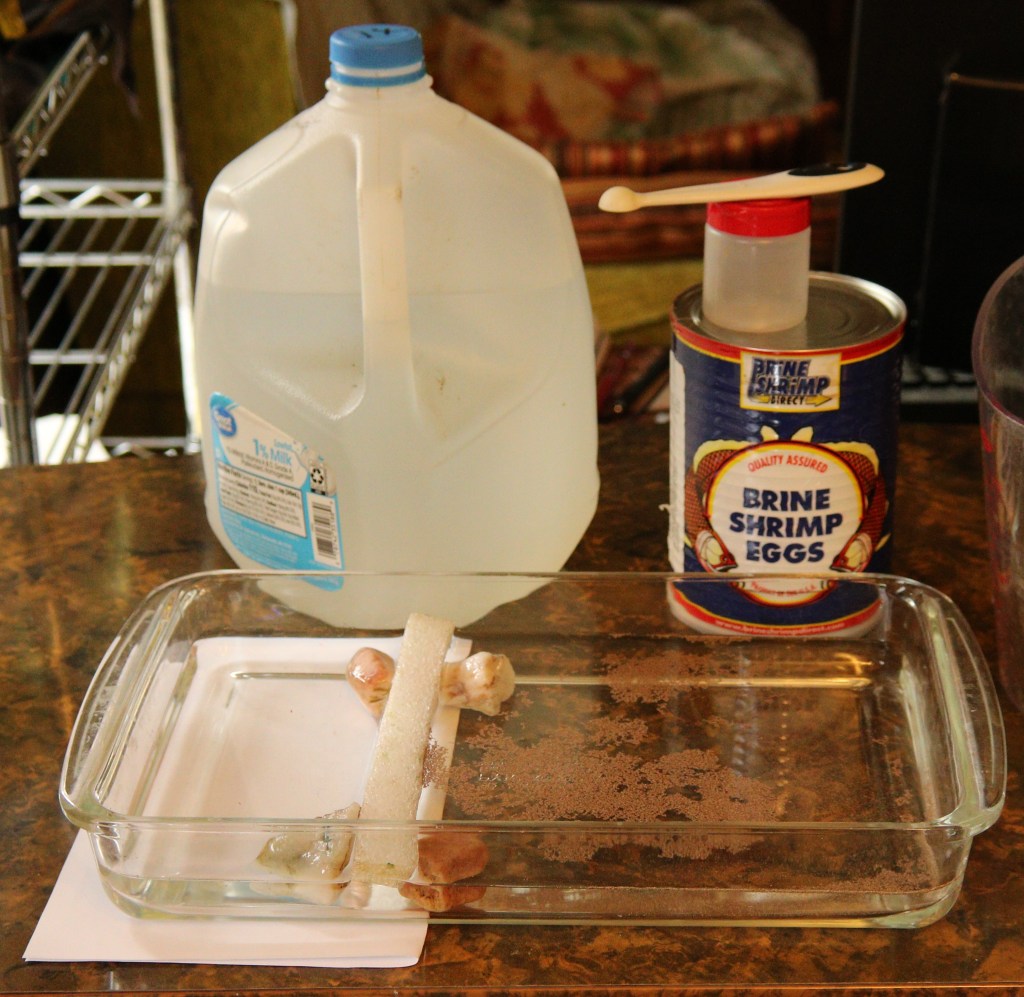
For several years, I have been using my new easy “dish method” for hatching brine shrimp eggs. No air pumps. No daily saltwater preperation and disposal. The dish method works perfectly for my small-scale setup–feeding a couple of batches of guppy fry and juveniles. My previous (2020) article ‘Hatching and Culturing Brine Shrimp (Artemia)’ describes various hatching methods. However, it does not include the dish method, which I had not yet developed. It is by far the easiest. Enjoy!
Dish Setup– Eggs stay on right side. After hatching, nauplii will swim to left side.
In November 2025, I gave a talk to the Bucks Co. Aquarium Society in Pennsylvania. Great club! During their auction, a bag of pretty Endlers caught my eye. I purchased them and am now crossing them with my Rainbow guppies. Goal is to increase the fitness of my guppies. [Forthcoming article in ALA newsletter (American Livebearers Association) explains why.]
All the females I used for the outcrosses were non-virgins with stored sperm, so I had to carefully pick out progeny that were truly F1 hybrids. Good thing, because the first, early batches were mixed (hybrids and non-hybrids).
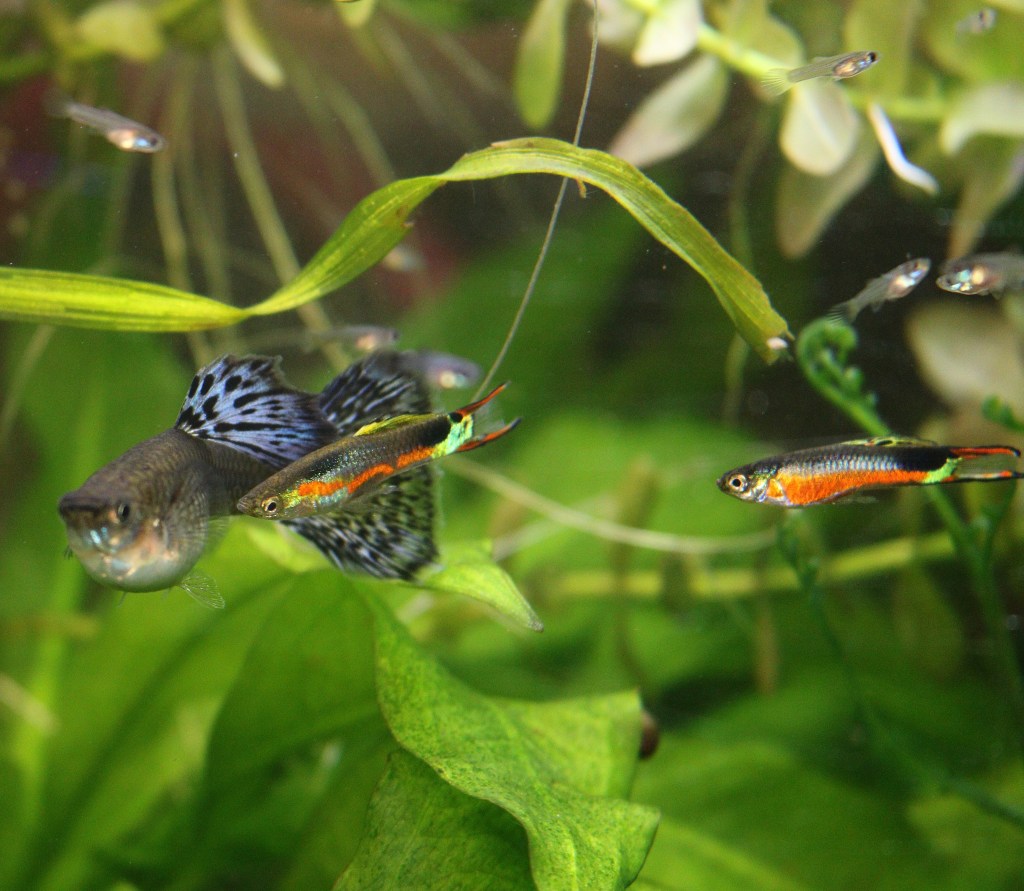
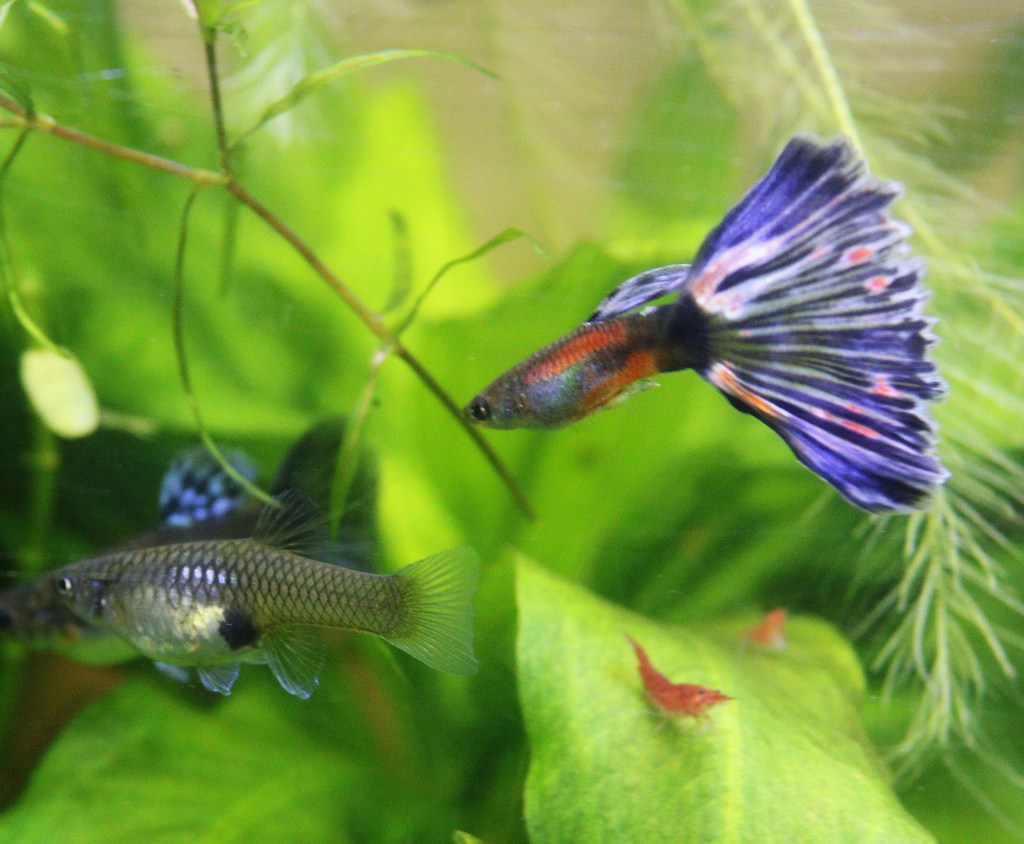
For the Endler male X female guppy cross (Photo), I picked out young female progeny with clear tails, a distinguishing feature of Endler females. So I was able to collect 5 nice virgin females from mating Endler males to a top Rainbow female.
Top Rainbow female guppy with young male Santa Maria Endlers. (This Endler strain is itself an Endler/guppy hybrid.)
For a reverse cross, I mated my best Rainbow males to Endler females (Photo). I identified hybrid females as Rainbow-sired by their darker, pigmented tails.
Top Rainbow male with Santa Maria Endler female.
This is a long-term project. So far, I am pleased with the progress. When I began, I was not sure how to identify hybrid females. But now I have 5 very fine virgins from each of the 2 outcrosses. I plan to mate them to my best young Rainbow males.
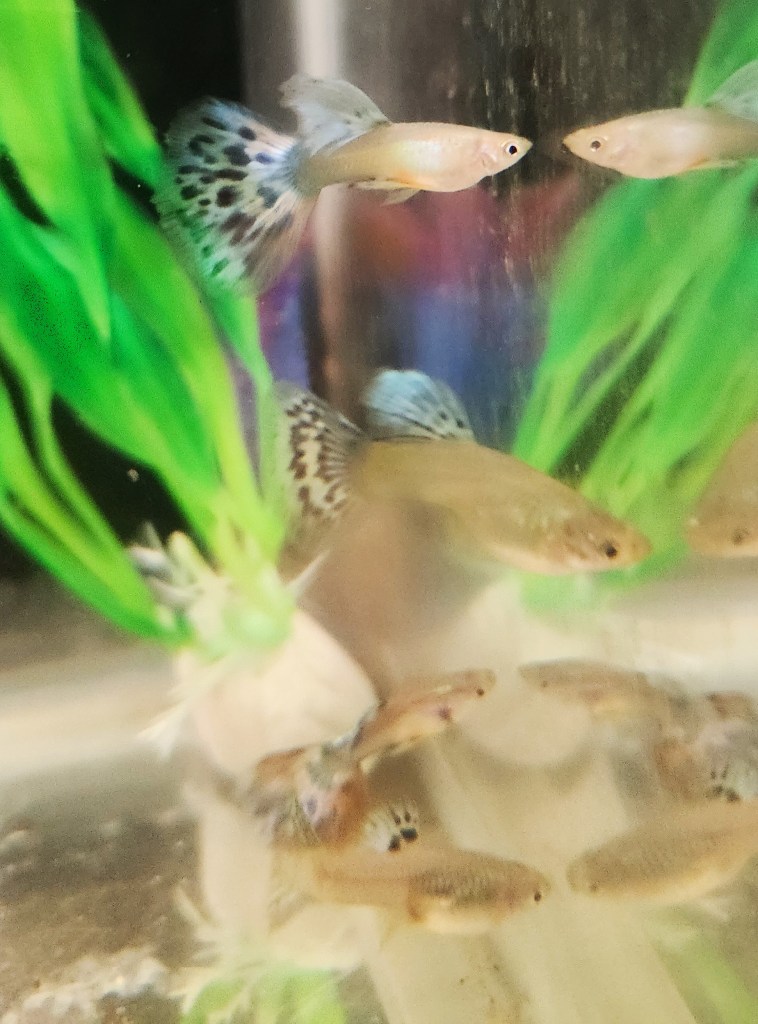
I’m fairly new to shipping my fish, so when two purchased pairs–going to Illinois USPS Priority Mail–were delayed 3 days, the buyer and I were prepared for the worst–but hoped for the best. The upshot was that guppies shipped on Tuesday didn’t arrive until the following Monday, meaning 6 days in transit. Happily, they arrived alive and in good shape. Buyer reported the fish were doing great and sent me pictures (photos). (Fish color is bleached out in photos.) Note: I have a nice selection of guppies now, but I will be selling guppies on Sept 20, 2025 at the Sustainablereef extravaganza. Will I have any left? And I’m not sure I will be shipping during winter and holidays….
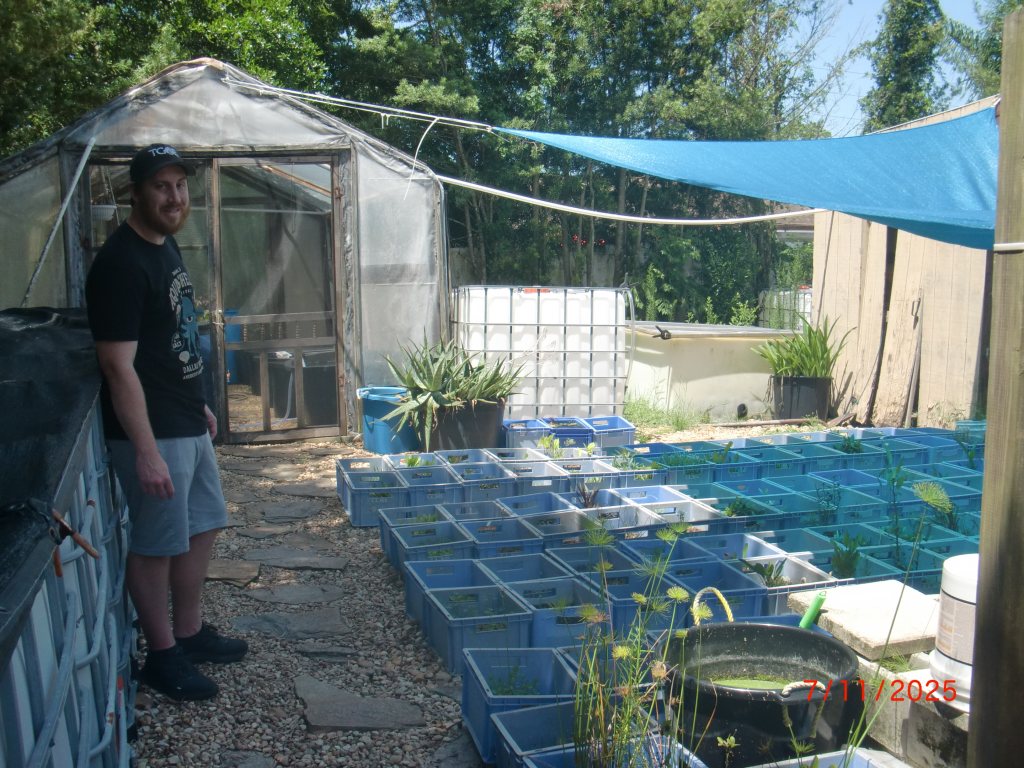
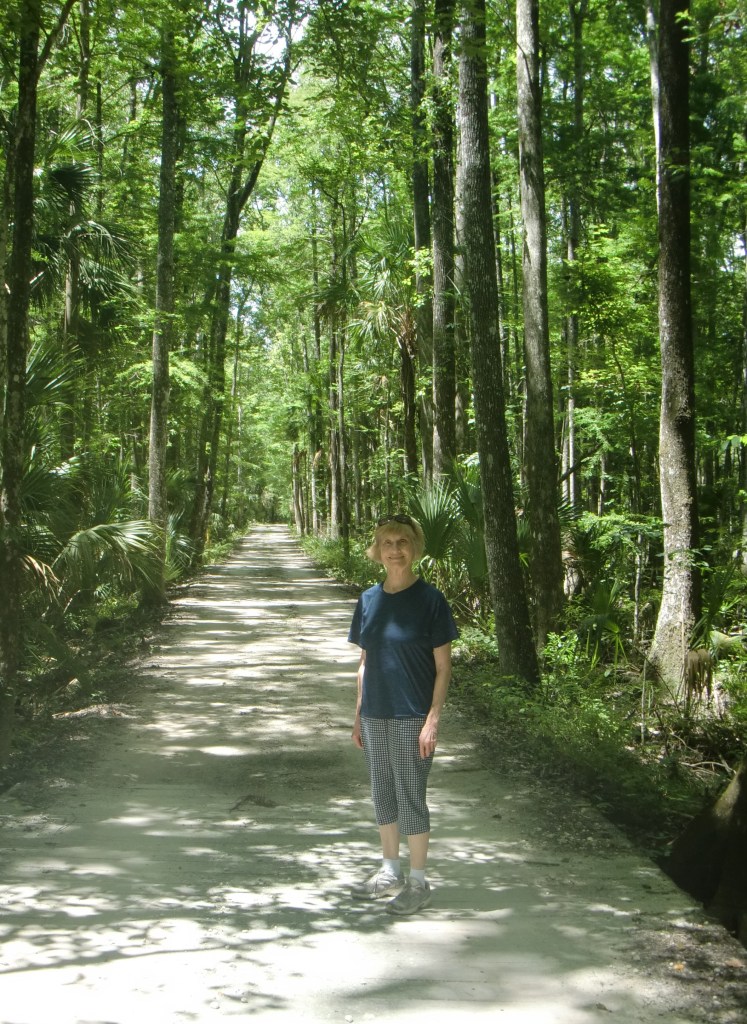
My visit to Spring Hill, Florida to give talk for the PASCO aquarium club on July 12, 2025 was a resounding success. Talk was well-received and I sold lots of books. Grant Eder, owner of Garden of Eder, an expert and popular vendor of Neocaridina shrimp, was my gracious host for 2 days. He has a houseful of tanks and a yardful of outdoor tubs (Photo). He took me and his family to visit the Chassahowitzka State Park. There he and his daughter waded through streams to catch fish. (All fish were returned to their homes after photographing.) Lots of fish, including many Mollies (Photo). Meanwhile, I stayed on dry land and kept my shoes dry (Photo). I haven’t been on a plane for over 10 years, so this was a big deal for me!
Grant Eder with a backyard filled with tubs, plants, shrimp, turtles, Koi, etc.
Heavenly, clear water stream in the park filled with all different kinds of small fish, including several schools of Mollies.
Female Molly with crayfish. Male Mollies were few, gorgeous in color–and impossible to catch.
Me visiting the Chassahowitzka State Park in Spring Hill, Florida.
Recently, I did an interview conducted by Scott Wells, a cichlid authority with an informative website The Cichlid Stage. He questioned me about my personal history, planted tanks for cichlids, etc. You see, long ago I kept Tanganyikan cichlids. I have maintained a fondness for these fiesty, supremely intelligent fish and included a bit about their reproduction in my new book. (The females of one Lake Malawi species choose their mates by smell–not male color–via small odor peptides released by the male’s immune system. Heady stuff!) Photo from 1990 shows my 45-gal tank with a small colony of Tropheus dubosi and a beautiful golden male Lamprologous leleupi. Because I enjoyed these fish and working with Scott, I wanted to share his website and interview with my readers.